
(You must register and have a linked account first)
View Privacy Policy


OR

Show


Forgot your password?

Error message here!

Error message here!

Error message here!

Error message here!

Show Error message here!

Show Error message here!


Lost your password? Please enter your email address. You will receive a link to create a new password.

Error message here!

Back to log-in

Close

For Sale

The following items are listed by for sale by users of the site and dealers. They are in no way endorsed or guaranteed by www.oldswords.com

Add a Classified Item
to

Clicking on the sword will take you through to the relevant classified item or dealer site.
Don't miss out! - Do you want to be kept informed weekly of new aditions? Just join our weekly update list.

You can also receive regular email notifcations when items match your keywords. To recieve them just register or logon at the top right of this page.

Page 49 of 53
  • Nation : British
  • Local Price : £185.00
British 1876 Pattern Socket Bayonet, Egyptian Conversion for the Citadel Martini-Enfield, Dated 1888. Socket bayonet for the Egyptian .303 conversions of the Martini-Henry rifle, with fullered triangular blade and black leather scabbard with brass throat and chape pieces, the throat piece with teardrop frog stud. Blade 22 inches in length, muzzle ring diameter 16.5mm. The blade is stamped at the forte on its broadest face with a broad arrow and ‘WD’ War Department mark, a crown inspection stamp with ‘E’ for the Royal Small Arms Factory at Enfield, the manufacture date ‘6/88’ for June 1888, and two broad arrows point-to-point indicating equipment that was declared obsolete or to be sold off. Another face of the blade is stamped at the forte with an Egyptian mark: the numerals ۲۲۲. This is the Eastern Arabic numeral system (common to Farsi, Urdu, Pashto, Arabic and Kurdish) and means ‘222’, probably a serial number. The third face of the blade is stamped with some indistinct markings, probably more numerals, which have been cancelled with strikethroughs. The throat piece of the scabbard is stamped with another broad arrow and ‘WD’ War Department mark, and another crown inspection stamp with ‘E’. The frog stud is stamped with what may be a broad arrow. The leather scabbard body is stamped with two broad arrows point-to-point. Following the Anglo-Egyptian War of 1882 Britain gained effective political control of Egypt and to maintain order across the country it supplied local police and guard units with small arms. By 1903 the British army was rapidly reequipping with magazine-fed rifles and single-shot rifles like the Martini-Henry were available in large quantities. Martini frames were shipped to Egypt along with the tooling necessary to fit new barrels, converting them to fire the .303 cartridge instead of the original .577/.450. The rifles were rebuilt at the Arsenal of the Cairo Citadel between 1903 and 1908 by Egyptian gunsmiths and were issued to Egyptian police and prison guards. The converted rifles needed suitable bayonets – this is one of the 1876 Pattern socket bayonets also modified at the Citadel in the same period to fit the slimmer barrel and higher sights of the .303 conversions. This required modification of the sight bridge on the socket – in this case a channel has been cut through it to allow the sight to pass. The bayonets typically bear both their original British markings and added Egyptian ones. The blade is bright with some patches of light patination and speckled cleaned light pitting in one fuller. Its tip is intact. The socket was originally blued, this finish is present on the shank but has mostly rubbed off the socket except in recessed areas. The throat piece of the scabbard has some scratches. A previous owner also applied an adhesive label to it which created a visibly brighter patch on the brass. Some rubbing to the scabbard leather, all of its stitching is intact.
  • Nation : British
  • Local Price : £185.00
Argentine Type C Socket Bayonet for the FN FAL, Argentine Marines, Falklands War. Tubular steel one-piece bayonet with flash ports and spear-pointed blade with semicircular profile. Blade length 6½ inches (16.5cm), 11 3/8 inches (28.9cm) overall. Black plastic scabbard with eyelet chape, circular frog stud and steel throat piece, green canvas frog with retaining strap, plastic belt grip and wire hanger. The bayonet is inscribed on the blade with the serial number ‘02-73026’, applied with an electric pencil. The ’02‘ prefix indicates allocation to the Argentine Marines. The FN FAL infantry rifle and its bayonet were adopted by Argentina in the late 1950s, initially purchased from FN in Belgium but later made domestically by Argentine manufacturers. Several types of bayonet and webbing attachments were used by the Argentinean Army and Marines during the Falklands conflict: the tubular model was the ‘Type C’, compatible with later models of the FAL (post 1962) which had a 22mm muzzle device. This was used side by side with the ‘Type A’ knife bayonet, which fitted to the early FALs. The scabbards are not interchangeable between Types, the blades being of different shapes. Belt frogs for these bayonets are made of either green leather or nylon fabric: the ‘Correaje Argentino de Cuero’ (Argentine Leather Belting) load-bearing system was introduced around 1970, but incorporated some preexisting elements including leather frogs and pistol holsters, which were then painted green to match. The nylon ‘Correaje Tempex’ (Tempex Belting) was introduced in the early 1980s to replace it which included a new frog. Both forms of load-bearing system were still in use by 1982 so both were carried in the Falklands. Either frog will fit either Type of bayonet. After Argentine forces surrendered to the British on June 14 1982 their small arms were piled up by the thousand in the Islands’ capital Port Stanley, where most Argentine forces had been deployed or driven back to. A large quantity of arms had also been captured earlier at Goose Green, which was a key ammunition dump for the Argentine forces, and still more were gathered later from unengaged Argentine garrisons on the island of West Falkland. The FAL rifles became British government property and were either brought to the UK or dumped at sea, while bayonets and the short machete-like officer’s sidearms frequently became personal trophies or souvenirs for British soldiers as they would not be illegal to own in civilian life. This example is most likely one such ‘bring-back’. The bayonet has its original blued finish, with black paint on the release catch. Some minor rubbing to both these finishes on raised edges. The blade has some spots of patination, a few light dents to the blunt ‘edge’ of the blade on one side. The tip of the blade has rolled (
  • Nation : Australian
  • Local Price : £180.00
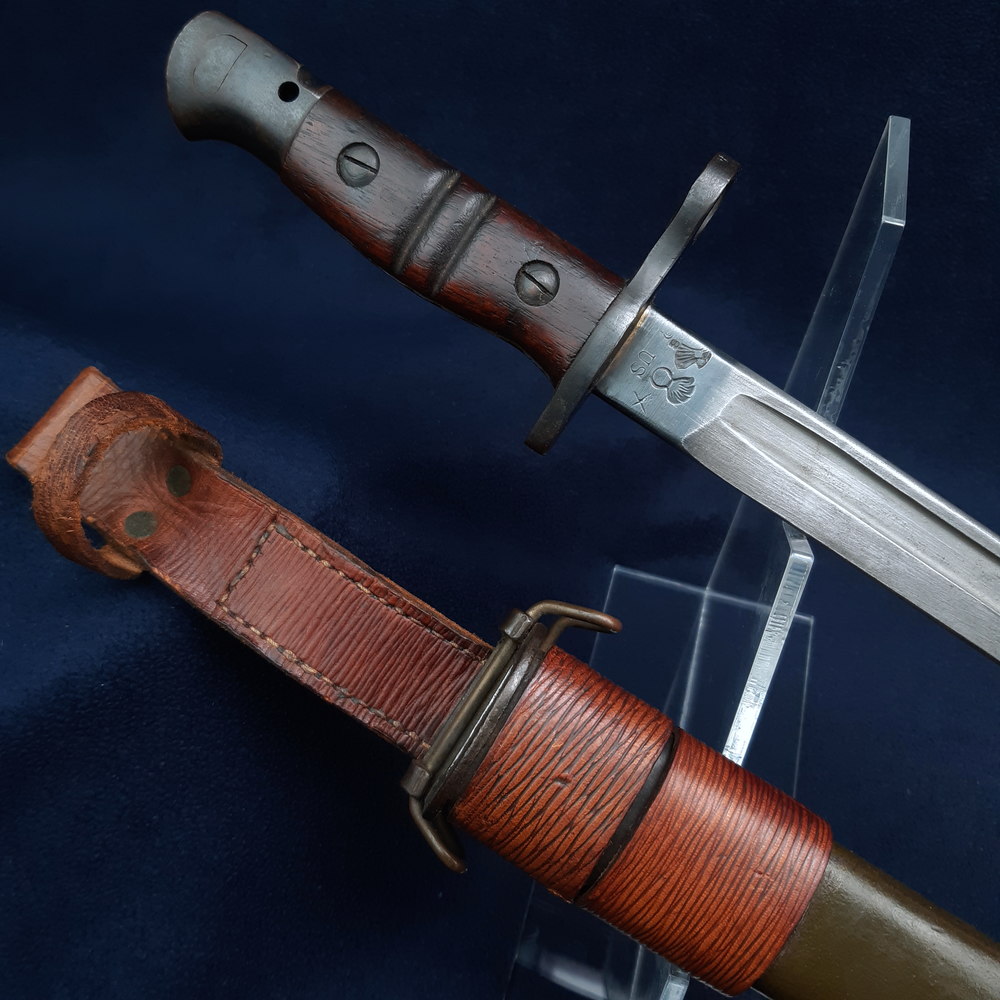
Australian WW2 Lee Enfield 1907 Pattern Bayonet by Orange Arsenal, Dated 1944. Straight single-fullered knife blade, steel hilt with muzzle ring, wood slab grips secured by two screws, steel beaked pommel with locking button. Black leather scabbard with steel locket & round frog stud and steel chape piece. The ricasso is stamped on one side with ‘MA’ for Munitions Australia, over ‘1907’, the model, over ‘1’, as well as a broad arrow War Department mark, the manufacturer’s mark ‘OA’ indicating the Orange Arsenal, and an ‘X’ indicating that it passed a manufacturer’s bending test. On the other side it is stamped with another ‘MA 1907 1’ mark and the manufacture date 4 ’44 indicating April 1944. One of the wood grips is stamped between the screws with ‘SLAZ 43’ and the other with ‘SLAZ 44’, indicating that they were produced in 1943 and 1944 by the Slazenger company, better known for its sporting equipment. The throat piece of the scabbard is stamped next to the staple with another ‘OA’. The chape piece is stamped next to the staple with a seven-pointed star. The leather section of the scabbard is stamped next to the seam with ‘MANGROVITE 44’. The blade has an even dark parkerised finish with some wear only along the spine from rubbing upon sheathing and drawing, exposing bright steel. The hilt, exposed tang and pommel likewise are darkly parkerised. The grips have some abrasion next to the pommel – possibly deliberately shaved down to better fit it to the pommel – and are otherwise excellent. The throat piece of the scabbard has some light scratches showing bright steel and some rubbing to the finish on the frog stud, likewise some rubbing to the tip of the chape piece. The leather of the scabbard has some light denting and surface rubbing.
  • Nation : Spanish
  • Local Price : £180.00
Portuguese M1886 Kropatschek Bayonet by Steyr. Yataghan curved single-fullered blade, crossbar hilt with upper muzzle ring and quillon and lower circular finial, black wood grips, plain steel scabbard with frog hook. No maker’s mark to the spine of the blade – it may have been removed by polishing. The frog stud of the scabbard is marked ‘WG’, a Steyr factory mark. Hilt marked ‘N159’, scabbard marked at the throat with ‘RR884’. The M1886 Kropatschek rifle proved to be reliable and had a long service life - while it was replaced by the 1904 Mauser in the Portuguese army it was used by colonial units in WW1, issued to the Portuguese Legion during the Spanish Civil War, and was still in use by colonial police as late as the 1960s. Its bayonet was one of the last to make use of the ‘yataghan’ downward-curving blade.
  • Nation : British
  • Local Price : £180.00
US Model 1917 Bayonet with Home Guard Frog, by Remington 1917. Straight single-fullered blade with spear point, steel hilt with muzzle ring, wood slab grips secured by two screws, steel beaked pommel with oil hole and locking button. Olive green painted leather scabbard with steel locket & chape fittings, brass webbing hooks, brown leather frog with belt loop and retaining loop. The blade is stamped on one side at the ricasso with the Shell and Flame (aka Flaming Bomb), the mark of the US Army Ordnance Branch, below which is ‘U.S.’, as well as an eagle head inspection mark and an ‘X’ indicating that it passed a manufacturer’s bending test, and on the other side with the manufacture date 1917 and a Remington roundel manufacturer’s mark. One of the wood grips is stamped between the hilt and the nearest screw with ‘SS’, the meaning of which I am unsure of. The leather of the scabbard is stamped on the rear side on one side of the seam with ‘H.E.’ and on the other side with ‘JEWELL 1918’ indicating the leather section was made by the Jewell Belting Company of Hartford, Connecticut in that year. The chape piece is stamped next to the staple with two faint letters which I believe are ‘M.S.’ for the Maxim Silencer Co., a subcontractor which made these parts, frequently seen paired with Jewell bodies. Due to the outbreak of WW1, manufacture of the new British P1914 Enfield rifle was contracted out to American manufacturers Remington and Winchester, including its matching 1913 Pattern bayonet. After the United States entered WW1 in 1917 the factories that had been producing for the British switched to supplying the same products to the US Army. In US service the P1914 Rifle became the ‘United States Rifle, Model of 1917’ with accompanying ‘Model 1917’ bayonet – both direct copies, now with US markings. However, the distinctive pattern of frog that has been fitted shows that this bayonet did see use in British hands after all: it was issued to the British Home Guard during WW2, who were often armed with the M1917 or P1914 rifles, no longer standard issue but which still used current cartridges. The blade has a clean parkerised finish, with only one spot of light patination near the tip on one side. It retains its original blued band at the ricasso. Its edge is sharp, particularly so near the tip where there are visible sharpening marks, with no edge damage. The tip appears at first to be fractionally chipped but there is a ground bevel up to it on both sides leading me to think it was deliberately sharpened into a stronger, ~1mm wide point. The hilt, exposed tang and pommel retain their original blued finish, with very little wear even on raised edges like the locking button. The wood grips have only a few small dents. The scabbard fittings have a blued finish with very little wear, some light cleaned rust spotting to the chape piece. The leather of the scabbard has a few dents to its front face, it remains glossy with very little rubbing wear or colour fading. The frog remains flexible and strong, with some dents to the scabbard loop as well as one tiny flap to the leather on one edge (~5mm across) which I have glued down, some abrasion to the retaining loop and at the edges of the belt loop.
  • Nation : British
  • Local Price : £180.00
British Lee Enfield 1907 Pattern Bayonet, Rugby School Officers Training Corps. Straight single-fullered knife blade, steel hilt with muzzle ring, wood slab grips secured by two screws, steel beaked pommel with oil hole and locking button. Black leather No. 1 Mk 2 scabbard with steel locket & teardrop frog stud and steel chape piece. 1925 Pattern khaki canvas frog with retaining loop and distinctive brass button to clip the frog to the belt. The ricasso is stamped on one side with a crown, 1907 (the pattern) ‘9 17’, indicating the manufacture date of September 1917, the manufacturer’s mark ‘SANDERSON’, four crown inspection stamps (three with ‘E’ indicating the Royal Small Arms Factory at Enfield), and multiple reissue stamps dated ’27, ’31 and ’39. On the other side it is stamped with a ‘broad arrow’ War Department stores mark, three more crown inspection stamps with ‘E’, and an ‘X’ indicating that it passed a manufacturer’s bending test. The pommel is stamped with ‘O.T.C’ over ‘RUG’ over ‘283’. This indicates that this was bayonet number 283 used by the Rugby School OTC (Officers’ Training Corps). The throat piece of the scabbard is stamped with a diamond-shaped manufacturer’s mark. The leather of the scabbard is stamped next to the seam with two further crown inspection marks, a broad arrow and an illegible mark which would be the manufacture date - all these marks being faint from rubbing. A large number of volunteer units sprang up across the United Kingdom during the late 1850s after a national appeal by the Secretary of State for War, due to a perceived threat of invasion of Britain by France. Oxford and Cambridge universities were very quick to respond with the formation of their own units of Rifle Volunteers, and some schools also followed suit, Rugby being one of the first wave of six schools to form their own Corps in 1860. As years went by the number of school units only increased until by 1898 there were 39, with another surge of interest due to the Boer War nearly doubling that number by 1902. These school units provided early experience for young men who would then be in a good position to move up to the university units and perhaps a military career afterward. There was lively competition between Corps for shooting prizes in particular, with Rugby one of the most successful – although it may be said that success came in part with a school’s willingness to spend on equipment and training. The Officers’ Training Corps were established in 1906 as part of the wide-ranging Haldane Reforms to the British Army’s structure. The OTCs were intended to alleviate the shortage of trained officers in the various volunteer units (Militia, Yeomanry, Volunteer Force and Reserve of Officers) by forming a system of junior training units in public schools and senior ones in universities. Some of the junior OTCs were formed out of the existing school Cadet Corps, which by this date numbered more than fifty, while senior OTCs were often formed from the university units. During WW1 the OTCs became training units for supplying officers to the regiments, an OTC Certificate generally considered full qualification to become an officer, although some individuals chose for various reasons to enlist in the ranks. Rugby School OTC supplied 291 recruits, all of them gazetted officers, between August 1914 and March 1915. The Rugby School Cadet Corps still exists today as part of the Combined Cadet Force (CCF), with Army, Royal Marines and RAF contingents. Under the modern Army structure it serves as a leadership and training organisation, teaching a number of military skills but with no obligation to go on to full military service. Because of its features this bayonet must postdate 1910, and was probably issued to replace the 1903 Pattern bayonets that were initially issued to school Corps. Its frog is quite a scarce pattern: the 1925 Pattern frog was issued to the RAF and in fact was not made in khaki until 1932 when the Canadian government appears to have ordered a number of them from the Mills Equipment Company. The 1937 Pattern generally replaced these so it may have been handed down as surplus and found its way to an OTC unit – as its reissue marks attest this bayonet was still in use as of 1939. The scabbard is not actually fully fitted into it – it arrived this way and I do not wish to force the stiff canvas too much to get the frog stud into it, although I think there is enough give. The blade has a matt parkerised finish with streaks of rubbing, some scratches and spots of light patination. Some small nicks to the sharpened edge near the tip, the tip rounded. The blued band at the shoulder of the blade is intact. The hilt, pommel and scabbard fittings are blued with some light rubbing on raised edges, but have also been impacted by rust leading to areas of moderate to heavy pitting and encrustation, the latter most notable on the throat piece of the scabbard. While this is removable by polishing, that would also remove the remaining blueing. Only a few small dents to the wood grips. The leather scabbard body has some light dents and surface abrasion. All the scabbard’s stitching remains intact.
  • Nation : South African
  • Local Price : £175.00
1960’s South African No.9 Bayonet By Armscor Subsiduaries For No.4 SMLE Rifles & Scabbard. BAYO 50 -. BAYO 50 These bayonets produced in the 1960’s by Armscor Subsiduaries have a socket identical to the British No.9 Bayonet bayonet but with a blade from the UZI SMG bayonet. According to Skennerton these bayonets were made to fit No.4 rifles carried by South African Local Defence Force Commandos (see page 370 item 6 of Skennerton’s book British & Commonwealth Bayonets). They were issued in both reinforced fibreglass scabbards and as in the case of our example steel scabbards from UZI bayonets. The bayonet has an excellent clean blackened 6 ¾” single edged blade and pommel with ribbed release button. The scabbard with frog stud has original black paint and no dents. These bayonets are not commonly found on the collectors market. Price includes UK delivery. BAYO 50
  • Nation : -
  • Local Price : £175.00
Yugoslavia M1924 Bayonet And Scabbard. BAYO 271 -. BAYO 271 This is a nice 1924 pattern bayonet made to fit the Belgian FN24 an FN30 and the Czech VZ24 rifles which the Yugoslav army was using at that time. The Kragujenac Arsenal also made the FN24 rifle and bayonet under licence. This is a Yugoslav made bayonet as it has the distinctive grip bolt head used by the Yugoslavians which requires a special bifurcated tool to remove them. The blade is heavily blued as is the pommel. The crossguard carries the number 4329 and an indistinct mark. The scabbard is all steel and the frog stud carries the number 36100. See An Illustrated History of Bayonets by Martin J. Brayley, page 252. This is an uncommon bayonet in very good condition. The price includes U.K. delivery. BAYO 271
  • Nation : British
  • Local Price : £175.00
British, Volunteer Battalions P. 1903 Pattern Leather Bayonet Frog For The Pattern 1903 Bayonet. -. L 270 This is a British Volunteer pattern black leather bayonet frog for the P1903 bayonet issued with the SMLE rifle. This was a new pattern of frog to replace the Slade Wallace buff leather frogs. The back of the frog is made by Hiatt’s of Birmingham in 1922 and us stamped on the back HIATT B’HAM 1922 A similar one can be seen on Plate 79, Bayonet Belt Frogs Part 1 by Anthony Carter. All of the stitching is intact on the frog. [Belts box]. The price includes UK delivery. L 270
  • Nation : German
  • Local Price : £175
German S84/98 Bayonet and Scabbard. -. BAYO 680 German S84/98 Bayonet and Scabbard. This is a wartime production bayonet and scabbard and is a third pattern with wood grips. It is marked to the blade with 42 cul which is the wartime code for WKC, Waffefabrik, Solingen Wald. This is repeated on the mouth of the scabbard. The other side of the blade carries 5940 and the pommel has two Waffenampt stamps. The scabbard is steel and has the numbers 963? Stamped to the top. The tip of the scabbard also carries a Waffenampt stamp. The bayonet has obviously seen action but is in good collectable condition for a wartime dated example. See Martin.J.Brayley, an illustrated history of bayonets page 86. £175. BAYO 680.
  • Nation : German
  • Local Price : £175
German late WW2 M88/89 3rd Model Bayonet & Scabbard. -. BAYO 677 This is a late production K98 bayonet made in 1944 by E & F Horster and marked to the blade with their wartime code of 44asw. There is only one visible waffenampt stamp to the pommel and the overall finish is not up to the usual standard. The scabbard is also a late war version with the finish not being as good as normal. This is marked to the top with 44cof which is the wartime code for Carl Eickhorn. A nice late war combination and a must for the serious collector. See White & Watts No 296 pages 115 & 133. £175 BAYO 677.
  • Nation : German
  • Local Price : £175
German WW2 M88/98 3rd Model Bayonet & Scabbard. -. BAYO 675 This is a nice 3rd model K98 bayonet with wood grips. Blade length 10”. Overall length 15”. It was made by Mundlos AG, Maedebure Nord and is marked to the blade with their wartime code of 5244G. The blade retains all of its original bluing. There are two Waffenampt stamps to the pommel. The scabbard is stamped with 42 cof which is the wartime code for Carl Eickhorn. A nice wartime combination by a lesser manufacturer. See White & Watts No 295 pages 115 & 132. £175. BAYO 675.
  • Nation : German
  • Local Price : £175
German Firemans Dress Bayonet & Scabbard. -. BAYO 667 This is the long version of the Firemans Dress Bayonet as worn by the ranks of Feuerwehrmann to Brandmeister. WW2 era. It has a 9 ¾ “ blade with wide fullers and a recurving or ‘S’ shaped crossguard. The Pommel is solid with no mortise slot or release button and the grips are black chequered plastic. There is a very fine old hairline crack in one of the scales. Both scales are very solid and secure. There are no makers or other marks to the blade. The scabbard is the standard black type. See German clamshells and other bayonets by Gary. L. Walker & R.J.Weinand pages 125 & 126. BAYO 667 £175
  • Nation : German
  • Local Price : £175.00
WWI Imperial German Model 1888/98 Ersatz Bayonet and Scabbard. BAYO 288. -. BAYO 288 This is an original nice example of a WWI German Ersatz M88/98 bayonet with solid steel hilt. The bayonet has a half hoop, one piece stepped muzzle ring. The bayonet has a 12 1/8" with an overall length of 17 inches. The bayonet is complete with its original steel scabbard. The all steel scabbard retains a small section of original green paint around the frog stud. See page 143 & 153, The Bayonet Book by Watts & White for a virtually identical example. The price includes UK delivery. BAYO 288. (Box 2)
  • Nation : German
  • Local Price : £175.00
Post WW2 German Eickhorn Commercial M16 knife Bayonet With Wire Cutter & Scabbard. BAYO 8 -. BAYO 8 This is an excellent Post WW2 German Made Commercial M16 Assault Rifle bayonet With Wire Cutter & Scabbard. There are no makers marks on this knife but most of these bayonets were German made by Eickhorn, Solingen. These bayonets fit M16 Assault rifles and many other modern rifles. It has a broad black ribbed grip and short steel crossguard with muzzle ring. It has a 7" Bowie type blade with sawback (overall 12"). The blade is slotted for wire cutter attachment which is present on it's original blacked scabbard with integral webbing frog (The wire cutting action works perfectly). The frog has a belt loop with retaining strap, stud fastener and steel belt hanger. The base of the scabbard is fitted with green thigh cord. Price includes UK delivery. BAYO 8
  • Nation : -
  • Local Price : £175.00
Czech Knife Bayonet For Model 58 Rifles & Scabbard. BAYO 6 -. BAYO 6 This is an excellent Knife Bayonet for Czech Model 58 rifles. The bayonet has a 6 3/4" parkerised single edged fullered blade with medial ridge. It measures 11 1/2" overall. The blade is stamped with the number '3801M'. The reverse is stamped '114'. It has curved wood grips and is without muzzle ring. It's leather scabbard is in similar excellent undamaged condition. It has a single angled belt loop, retaining strap and stud fastener. The rear is ink stamped with a 'crossed swords 64' ink stamp and partial circular ink stamp at the rear lower tip. All leather & stitching are intact. Price includes UK delivery. BAYO 6
  • Nation : -
  • Local Price : £175.00
Czech Knife Bayonet For Model 58 Rifles & Scabbard. ED 2260 -. ED 2260 This is an excellent Knife Bayonet for Czech Model 58 rifles. The bayonet has a 6 3/4" parkerised single edged fullered blade with medial ridge. It measures 11 1/2" overall. It has the early version short tang which incorporates the bayonet bar slot. The blade is stamped with the number 'P4313'. The reverse is stamped '02'. It has curved wood grips and is without muzzle ring. It's leather scabbard is in similar excellent undamaged condition. It has a single angled belt loop, retaining strap and stud fastener. The rear is ink stamped with a 'crossed swords' ink stamp and partial circular ink stamp at the rear lower tip. All leather & stitching are intact. Price includes UK delivery. ED 2260
  • Nation : -
  • Local Price : £175.00
A ‘Namban’ Style Iron Tsuba for a ‘Tanto’ (Dagger). ED 2699. -. ED 2699 Namban means foreigner in Japanese. This Tsuba is made from very hard iron. These were made in various locations from the 16th & 17th Centuries. Nagasaki, Kyoto and Hizen. They were also made in trading enclaves off the coast of China in the 17th Century. This Tsuba looks to be late ‘Edo’ 1780 into the 19th Century. With ‘Tsukashi ‘piercings of dragons and ‘Tama’. In very good condition, the price includes UK delivery. ED 2699.
  • Nation : -
  • Local Price : £175.00
Danish M5 Bayonet, Scabbard and Webbing Intergral Frog. Bayo 273 -. Bayo 273 This is a scarce Danish bayonet issued in 1962. It is identical to the U.S. M5 but is contained in a wood grained scabbard. It was issued in small quantities as the Haerens Tekniske Korps Model 1962. The pommel is stamped with a Crown over 'HTK M62' which signifies the Army Technical Corps Model 1962. The grips are black plastic and secured with two screw bolts. The bayonet has a thumb release tab which is located near to the crossguard, it operates smoothly. The scabbard is wood grained and the top mount carries a crown over HTK The webbing integral frog is a more elaborate version of the American type. This bayonet fits the M1 Garand rifle which Denmark had been using since 1950. The bayonets were made in Germany under licence. Not a common bayonet on the collectors market. (See 'An Illustrated History of bayonets' book by Martin J Brayley, page 61). The price includes UK delivery. Bayo 273
  • Nation : -
  • Local Price : £175.00
Belgium Unusual Conversion Of A Belgian Albini-Braendlin Socket Bayonet. BAYO 587 -. BAYO 587 This is an unusual conversion of a Belgian socket bayonet. The socket has had a long groove cut into the top of the socket. Possibly for raised sights. The locking ring has a spade type screw fixing for hand tightening. The blade is 17 ½” long. The socket measures 3” long with a muzzle ring diameter of 24mm. The leather scabbard is of the type used for the Albini-Braendlin socket bayonet and this bayonet fits the scabbard perfectly. There is a number 4?807 stamped into it. This bayonet is worthy of further research. The price includes U.K. delivery. BAYO 587
  • Nation : Japanese
  • Local Price : £175.00
20th Century Japanese Gilded Soft Metal Dragon Decorated Kogai For Japanese Wakizashi Sword Fittings. ED 3057 -. ED 3057 This Kogai has been examined by UK Japanese sword expert Bill Tagg. His descriptive note accompanies the Kogai. His note reads “Japanese Kogai (scabbard side knife / bodkin). Gilded soft metal with blackened background to Dragon detail in panel. Looks mid 20th century made. In very good condition suitable for wakizashi size sword”. The price includes UK delivery. ED 3057 (in Tanto box armoury)
  • Nation : South African
  • Local Price : £175.00
1960’s South African No.9 Bayonet By Armscor Subsiduaries For No.4 SMLE Rifles & Scabbard -. BAYO 640 These bayonets produced in the 1960’s by Armscor Subsiduaries have a socket identical to the British No.9 Bayonet but with a blade from the UZI SMG bayonet. According to Skennerton these bayonets were made to fit No.4 rifles carried by South African Local Defence Force Commandos (see page 370 item 6 of Skennerton’s book British & Commonwealth Bayonets). They were issued in both reinforced fibreglass scabbards and as in the case of our example steel scabbards from UZI bayonets. The bayonet has an excellent clean blackened 6 ¾” single edged blade and pommel with ribbed release button. The scabbard with frog stud has original black paint and no dents. These bayonets are not commonly found on the collectors market. The price includes UK delivery. BAYO 640
  • Nation : German
  • Local Price : £175.00
*German ‘G3’ Bayonet and Scabbard. BAYO 738. -. BAYO 738 This is a ‘G3’ bayonet to fit the German ‘G3’ rifle. Based on the Spanish ‘CETME’ rifle and introduced in ‘1959’. It has undamaged ribbed plastic grips and a blade similar to the American ‘M3’ knife blade. The bayonet fixed to the rifle in an inverted position above the barrel and was secured by a plug which fitted into the gas port of the rifle. The original German issue scabbards also followed the American pattern of ‘M8 & M8A1’ types. As the popularity of the ‘G3’ rifle grew it was exported to over 60 countries, and our example is one of these export versions being in a black plastic scabbard with a fixed belt frog. This is a nice example that has seen some use. See ‘Martin. J.Brayley- An Illustrated History of Bayonets’ pages 87 – 101
  • Nation : -
  • Local Price : £175.00
A ‘Meta Zashi’ style ‘Tanto Dagger’ Tsuba in Iron. ED 2697. -. ED 2697 A ‘Tanto Dagger’ Tsuba (A tsuba is a sword guard and part of a sword mounting. It is mounted between the sword's blade and grip to protect the user's hands) made from iron depicting a boatman and wild geese or ducks. It has a lovely wet look to the iron with good patination. This is possibly ‘Aizu Shoami’ work from the early 19th Century or slightly earlier. The open ‘Hitsu’ identifies this as a ‘Meta Zashi’ style Tsuba. The price includes UK delivery. ED 2697.
  • Nation : Japanese
  • Local Price : £175.00
1902 Dated Japanese Made Siamese Mauser Bayonet & Scabbard. BAYO 246. -. BAYO 246 This is a Mauser rifle bayonet imported by Siam (now Thailand). It has an overall length of 14 ½”and a blade length of 9 ¾”. The blade carries Thai script which translates to ‘RS121’. This indicates production in the 121st year of the Chakri Dynasty or 1902 in the Gregorian calendar. These bayonets were made in Japan for Siam (see pages 214 & 215 of the book ‘An Illustrated History Of Bayonets by Brayley’. The grips are wood held by 2 rivets. The scabbard is all steel and also has Siamese script to the mouth piece (all script illustrated). Price includes UK delivery. BAYO 246. (Box 1)
  • Nation : British
  • Local Price : £175.00
British 1907 Pattern Bayonet Scabbard and Webbing Frog. BAYO 377. -. BAYO 377 This is a nice 1907 pattern bayonet made by Wilkinson with quillon removed upon refirbishment. It is marked to the blade with a 1907(month of manufacture obscured) and Wilkinson. The other side carries several inspection stamps * the blade has a patina consistent with age*. The scabbard is the 2nd pattern with tear shaped frog stud, the leather and metalwork is in good order with all stitching intact. The webbing frog is also in good condition See Watts & White page 393 No820 for similar. The price includes UK delivery. BAYO 377. (07 Box 1)
  • Nation : British
  • Local Price : £175.00
British, WW1 Era, General Service Buff Leather Bayonet Frog For The P 1907 Bayonet. -. L 265 This is a buff leather bayonet frog adapted to take the P 1907 bayonet and was introduced in 1914 as a simpler way of altering General Service buff leather bayonet frogs to accept the P 1907 bayonet. The frogs were not altered but a leather piece was inserted and secured with 2 rivets. This modification caused the P 1907 bayonets to move further away and clear the leather frog. See Plate 93, Bayonet Belt Frogs Part 1 by Anthony Carter. All of the stitching and rivets are intact on the frog. The price includes UK delivery. L 265
  • Nation : South African
  • Local Price : £175.00
1960s South African No.9 Bayonet by Armscar Subsidiaries For No.4 SMLE Rifles And Scabbard. BAYO 420. -. BAYO 420 This is a bayonet unique to South Africa. The socket is virtually identical to the British No.9 bayonet but with a blade from the UZI sub machine gun. According to Skennerton, these bayonets were made to fit the No.4 rifle and were made in the early 1960s by Armscar. The bayonets were intended for use by the South African Local Defence Force Commandoes, see Skennerton’s book British & Commonwealth Bayonets, page 370, item 6. The bayonets were issued in both reinforced fibreglass scabbards and as in the case of in our example steel scabbards from UZI bayonets. The bayonet has an excellent clean blackened 6 ¾ inch single edged blade with a ribbed release button pommel. The scabbard has the original black paint on the scabbard and there are no dents in it. The price includes U.K. delivery. BAYO 420. (Box 3)
  • Nation : Japanese
  • Local Price : £175.00
**EXPERT ASSESSED**Japanese C1800-1850 Echizen Kinai Masters Style Wakizashi / Small Katana Sword Pierced Iron Tsuba. Sn 21038 -. 21038 This is an original C1800-1850 Iron Tsuba in the Echizen Kinai masters style. It has been assessed by UK Japanese sword expert Bill Tagg. His assessment & illustration of the tsuba can be read in the images and accompanies the piece. The price includes UK delivery. Sn 21038
  • Nation : Swedish
  • Local Price : £170.00
Swedish m/1914 Mauser Carbine Bayonet by Carl Gustafs Stads Gevärsfaktori. Introduced in 1894 for horseback and naval use, the m/94 carbine version of the 6.5x55mm Swedish Mauser did not originally come with a bayonet, but the cavalry, artillery and navy all demanded one, the navy even modifying a small number of rifles to accept the m/1867 yataghan bayonet in the interim. Prototypes were developed from around 1909, including a folding type, but were deemed unsatisfactory until the experimental model of 1913, which was trialled between 1913 and 1915, and adopted as the m/1914. A new nose cap with a bayonet mount was introduced for the rifle at the same time. Some were also used by Swedish troops serving as UN peacekeepers in the Congo between 1960-64, fitted onto the C version of the Carl Gustaf m/45 submachine gun. The Royal Guards at Stockholm Palace still carry the m/94 carbine and bayonet today. The blade is stamped at the ricasso on one side with the maker’s mark of a crown over the letter ‘C’ meaning the manufacturer Carl Gustafs Stads Gevärsfaktori (Rifle Factory of Carl Gustaf's Town). This was the state-owned arsenal at Carl Gustaf’s Town, which was another name for the industrial city of Eskilstuna, in Sweden. It is stamped on the other side with a crown. The scabbard finial is stamped on one side with the serial number 115. The other side of the finial and mouth of the scabbard are both stamped with a crown inspection mark. The blade is clean and bright with light track marks from sheathing and drawing, retaining its blued band at the ricasso. The scabbard, hilt, exposed tang and pommel retain nearly all of their blued finish, with light rubbing on raised edges revealing bright steel. The wood scale grips have a number of dents, no chipping or cracking and good colour. The scabbard body has a few very shallow dents, which do not interfere with smooth sheathing and drawing. The locking mechanism is fully functional.
  • Nation : Norwegian
  • Local Price : £170.00
Norwegian M1894 Bayonet Converted for the M1 Carbine. Unfullered spear-pointed blade, wood slab grips secured by a single screw, steel one-piece hilt, backstrap and pommel with integral sprung locking mechanism in the hilt, that both locks the bayonet to its scabbard and locks it onto a rifle. Muzzle ring attached by brazing, 1.45cm in diameter. Steel scabbard with projecting hook on the throat piece to engage with the locking mechanism, integral green canvas frog with wire loop webbing hooks and buttoned retaining strap, also attached by brazing to the scabbard body. Blade 20.6cm in length, 32.6cm overall. The blade is stamped at the ricasso with a crown and ‘K’, the maker’s mark of Kongsberg Våpenfabrikk (Kongsberg Weapons Factory). The hilt is stamped with ‘7’. The throat piece of the scabbard is stamped with the serial number ‘8174’. Norway received rifles from the United States under its Military Assistance Program from 1950 until 1963, with nearly 100,000 M1 and M2 Carbines delivered. The M1 was designated the Selvladekarabin M1 (Self-loading Carbine M1) in Norwegian service. Some US-made M4 bayonets for these rifles were delivered but were clearly insufficient in number, as Norway manufactured its own copy of the M4 bayonet at the Kongsberg arsenal, then opted to convert some of its existing stocks of M1894 bayonets made for the Krag Jorgensen rifle to fit the M1. Norway had an oversupply of this bayonet due to a new production run ordered in 1943 during their occupation by Nazi Germany. 30,000 bayonets were modified in 1956-57, probably at Kongsberg, by brazing on a new muzzle ring and modifying the locking mechanism in the mortise. A further 1,000 were converted by the Hærens Våpentekniske Korps. This is not one of the wartime production run (which have Waffenamt stamps, and lack a ball finial on the scabbard), but an original M1894, made between 1912 and 1926. All metal parts have a blued finish, with a small amount of wear on raised edges, eg the beak of the pommel. Some small dents to the chape end of the scabbard, which do not interfere with sheathing. One of the grip scales (on the inside as worn) has a small crack next to the locking button and denting to its surface.
  • Nation : Swedish
  • Local Price : £170.00
Swedish m/1914 Mauser Carbine Bayonet by Eskilstuna Jernmanufactur. Introduced in 1894 for horseback and naval use, the m/94 carbine version of the 6.5x55mm Swedish Mauser did not originally come with a bayonet, but the cavalry, artillery and navy all demanded one, the navy even modifying a small number of rifles to accept the m/1867 yataghan bayonet in the interim. Prototypes were developed from around 1909, including a folding type, but were deemed unsatisfactory until the experimental model of 1913, which was trialled between 1913 and 1915, and adopted as the m/1914. A new nose cap with a bayonet mount was introduced for the rifle at the same time. Some were also used by Swedish troops serving as UN peacekeepers in the Congo between 1960-64, fitted onto the C version of the Carl Gustaf m/45 submachine gun. The Royal Guards at Stockholm Palace still carry the m/94 carbine and bayonet today. The blade is stamped at the ricasso with the maker’s mark ‘EJAB’ with an anchor impaling the letter ‘E’, indicating the manufacturer Eskilstuna Jernmanufactur AB (Eskilstuna Iron Manufacturing, Inc). This was a private tool & cutlery manufacturer which produced bayonets for the Swedish military, based in the industrial city of Eskilstuna which also housed a state arsenal. The locking button, tang of the blade and finial of the scabbard are all stamped with a crown inspection mark. The blade is bright with some light frosting and some small spots of patination, retaining its blued band at the ricasso. The scabbard, hilt and pommel retain most of their blued finish, with rubbing on raised edges revealing bright steel. The wood scale grips are good with a few small dents and a short scratch on one side. The locking mechanism is fully functional and the bayonet sheaths and draws smoothly.
Page 49 of 53

The following items match your search but are currently listed on Ebay. We take no responsibility for any aspect of the listings or their accuracy.


Sorry, there is not any matching items.